Highlight
30 Gennaio 2026
Download the report: Gender Balance. Where does audiovisual production in Piemonte stand? (ITA)
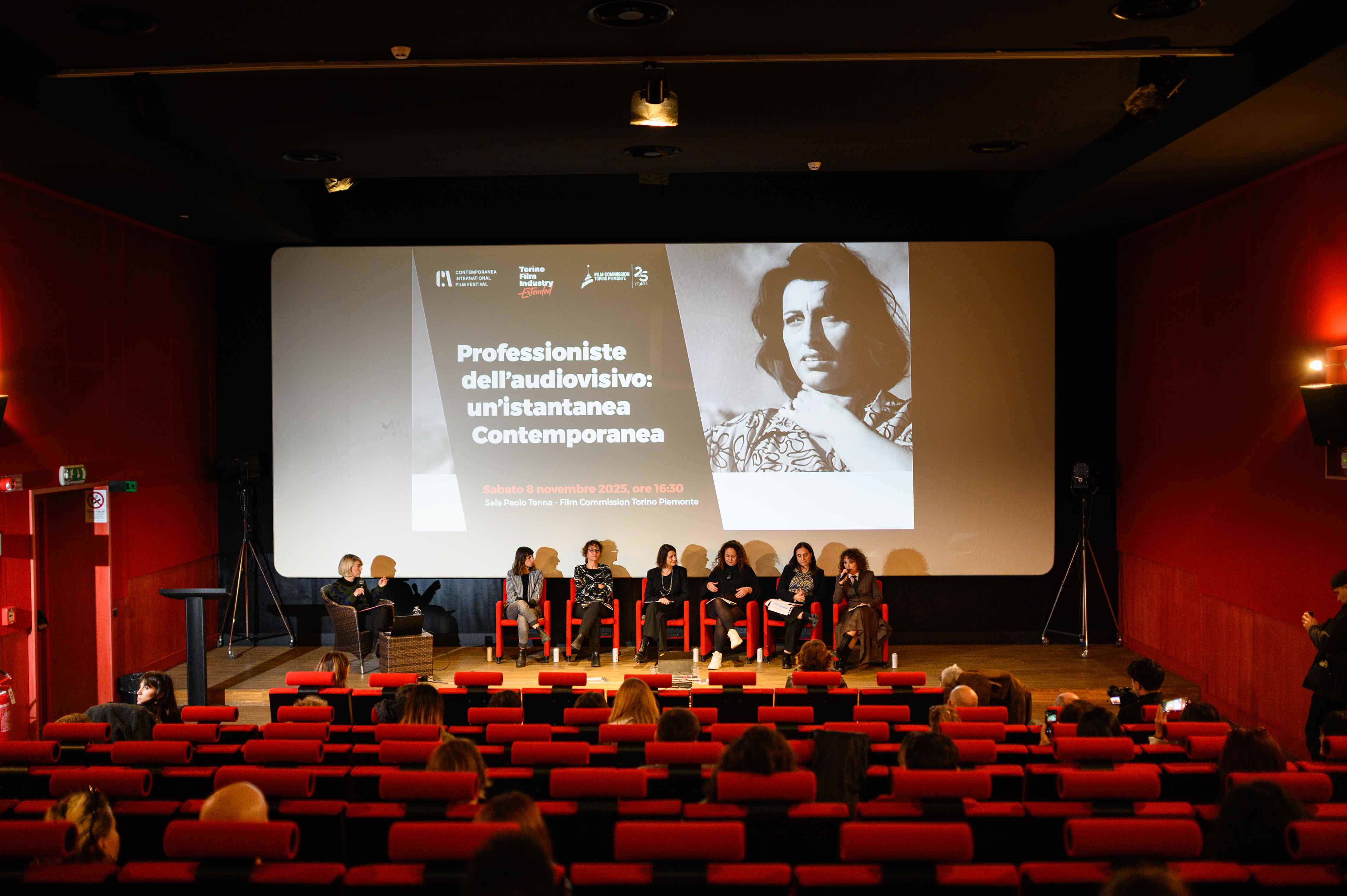
On November 8, 2025, "Professioniste dell'audiovisivo: un'istantanea Contemporanea" took place — a panel discussion under the TFI Torino Film Industry 8 Extended banner, promoted by Film Commission Torino Piemonte in collaboration with Contemporanea Film Festival as part of the "Lungo mese del cinema a Torino" project — an initiative conceived to bring the city's audiovisual sector together into an integrated calendar that transformed November and December into a single, city-wide event.
The panel was conceived and designed as a nationally significant moment dedicated to the condition of women professionals in the film and audiovisual supply chain. For the occasion, all relevant local and national experiences were brought together, with the live participation of representatives from Rete Cinema Piemonte, Women in Film, Television & Media Italia, Mujeres nel Cinema and DiversityLab, to take stock of the sector and analyse — through data and figures — the dynamics that hinder gender equality.
On this occasion, Film Commission Torino Piemonte presented the first gender analysis of its Production Guide, in line with a national and European framework that increasingly calls for the importance of data collection to fill a gap in analysis. In January 2026, it was decided to further define, consolidate and expand the research, leading to the publication of the report "Gender Balance. Where does audiovisual production in Piemonte stand?", which analyses the gender composition of audiovisual professionals in Piemonte using as its empirical basis the data from the Film Commission Torino Piemonte Production Guide updated to December 31, 2025.
This analysis continues the social accountability path undertaken by the Foundation with the publication of its Social Report. In particular, the initiative responds to the dual need to promote a strong data culture and to translate — with particular reference to gender equality — institutional commitment into concrete action. With the second edition of the Social Report, Film Commission Torino Piemonte formally committed to the global challenge of the UN 2030 Agenda, integrating the 17 Sustainable Development Goals aligned with its own mission to generate measurable impact on the economic and social development of the sector.
The analysis reveals a picture of persistent structural imbalance in the Professionals section of the guide, where female representation stands at an overall 37%. The gap becomes critically pronounced in senior and technical roles, with particularly low female presence in editing (5%), cinematography (7%) and directing (14%), with a total absence in the sound and music sectors. These figures are often below the national average, highlighting a professional segregation that confines the majority of women workers to departments traditionally considered female, such as costumes (100%), make-up (89%) and set design (80%). By contrast, areas such as screenwriting and location management show a stronger tendency towards gender balance.
An element of discontinuity and potential transformation is represented by the Beginners Guide, aimed at under-35 profiles. In this section, the gender paradigm appears reversed, with a female majority of 55%. The analysis highlights a significant increase in aspiring female professionals in historically male-dominated roles, such as directing (44%) and production (68%). However, a focused analysis of the 30–35 age group reveals a renewed decline in female representation to 44%, suggesting the persistence of systemic barriers at the critical transition from higher education to professional consolidation.
The research carried out by Film Commission Torino Piemonte is configured as a dynamic monitoring tool, aimed at transforming statistical data into an instrument of qualitative investigation and institutional intervention. Although incentive policies and the entry of new generations point towards an overcoming of the gender gap, the consolidation of genuine equality in senior roles remains a work in progress, closely tied to the capacity of the local market to absorb and valorise new female talent.
For further reading: TFI Specials | Gender Balance. Where does audiovisual production in Piemonte stand?
Pictured, from left: Chiara Borroni (Università di Torino), Laura Bolognino (Rete Cinema Piemonte), Fernanda Selvaggi (Rete Cinema Piemonte), Domizia De Rosa (Women in Film, Television & Media Italia), Karen Feier Ricci (Diversity Lab), Giulia Rosa D'Amico (Mujeres nel Cinema), Barbara Salerno (Fistel — Cisl)